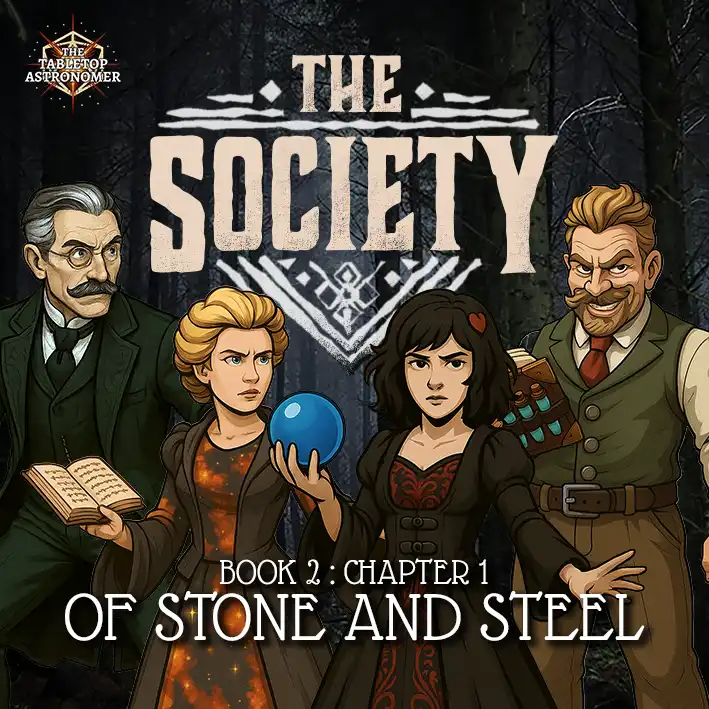
Vaesen: Of Stone & Steel: 01
Saturday, October 29, 1859
Morning light streamed through the high windows of the Society’s library, casting golden hues on the dust-laden tomes that Sigrid had gathered around her. She sat hunched over the thick pages, her fingers carefully tracing the faded ink as she searched for any connection between supernatural forces and weather phenomena. The storm at Stegeborg had left lingering questions, and she was determined to find answers.
The further she read, the clearer the links became—Lindworms, revenants, and trolls had recorded instances of controlling the weather. These beings were deeply connected to nature’s wrath, whether through ancient curses or a natural inclination to disrupt the balance of the world. Each tale hinted at unnatural storms, arriving at moments of great conflict or impending doom. Some stories spoke of omens preceding these storms—strange animal behaviours, flickering lights in the sky, and whispers on the wind that carried messages only the truly gifted could hear.
Meanwhile, in another section of the manor’s extensive library, Gottfried was occupied with his research. He flipped through pages detailing the effects of religious symbols on Vaesen. He found confirmation of what he had suspected—church bells, crosses, and holy relics were particularly repellent to many creatures of the unseen. Inspired, he called for Mr. Frisk.
“Find an urchin and have him procure four handbells,” Gottfried instructed, speaking with deliberate precision. “Each must be engraved with a cross. Nothing elaborate, but effective.”
Mr. Frisk, ever composed, nodded and disappeared on the errand without question. While he waited, Gottfried continued flipping through records of past encounters, noting how different symbols had varying degrees of effect depending on the nature of the Vaesen involved. He took notes in his meticulous handwriting, drafting ideas on how the Society might better prepare for future encounters.
Sebastian meticulously combed through newspaper archives at the Uppsala newspaper archive, scanning for reports of bizarre weather events. The lack of documentation was, in itself, suspicious. If there had been no recorded storms of this nature, it suggested that something unnatural was indeed at play. The silence in the records was almost more telling than any written account could have been. Frustrated but not deterred, he made a mental note to speak with locals and travellers who might have personal accounts of strange occurrences left unrecorded by the press.
In the Occult Library, Celeste was engrossed in her research. She poured over old texts detailing possessions, unnatural abilities, and beings that granted power at a cost. One entity appeared repeatedly—the Spertus. Described as a small, insect-like demon, it was known for forming pacts with those seeking knowledge or power, often leading to their ruin. The illustrations in the book seemed almost lifelike, the inky lines forming grotesque, scuttling shapes. Celeste shuddered and closed the book. She had other matters to attend to.
Intent on testing her skills, Celeste moved through the manor with silent steps, her presence a mere ripple in the air. She first ventured into the library, where Sigrid remained focused on her research. With measured breath, Celeste crept forward, a playful smirk forming as she reached toward Sigrid’s shoulder—
A sharp bark shattered the silence.
Kenan, Sigrid’s loyal hound, had spotted her instantly. The dog fixed her with a knowing stare, tail wagging in amusement. Sigrid, unfazed, turned slowly and arched a brow.
“If you plan to haunt this house, Celeste, you’ll have to do better than that,” she remarked dryly before returning to her book.
Undeterred, Celeste moved on to the basement shooting range, where Sebastian was refining his marksmanship. The rhythmic sound of gunfire echoed in the enclosed space. She adjusted her approach, her steps feather-light, timing her movements with his shots. Just as she was within reach, she whispered his name.
Sebastian reacted instinctively. He turned sharply, pistol raised, and fired. The bullet struck the reinforced ceiling with a sharp crack, sending dust raining down.
A long silence followed.
Lowering his weapon, Sebastian exhaled sharply, shaking his head as Celeste grinned mischievously.
“You nearly got yourself shot,” he muttered.
“I’ll take that as a win,” she replied with a smirk.
Mr Frisk, drawn by the sound of gunfire, arrived moments later, rubbing his temples. “One of these days, you’re going to take this house down brick by brick.”
Later that evening, Celeste called the group together for a séance. They gathered in the candlelit study, their faces half-shrouded in flickering shadows as they encircled the dagger they had retrieved from Thorleif.
Celeste placed her hands over the blade, closing her eyes. The room seemed to tighten around them, the air charged with an almost electric weight. The séance proved challenging—traces of its maker’s presence clung to the blade, complicating the ritual. But something responded. Celeste’s breath hitched as fragmented whispers filled the room, foreign words layered over one another, forming a language she could not recognise. The murmurs seemed to press against her mind, drawing her in. Images flickered in the candlelight—glimpses of hands crafting the blade, an unseen figure speaking words of power, the dagger resting on an altar bathed in moonlight. When the connection finally broke, she gasped, bracing herself against the table.
The others watched as she steadied herself, her skin pale, her breath uneven.
“There’s something bound to this blade,” she murmured. “Something old.”
Sebastian, sensing the need for grounding, suggested training exercises. He led Sigrid through a series of drills, simple but methodical, helping them refocus after the séance’s unsettling energy. The repetitive movements, the precise strikes, the discipline—combat, in its way, was a ritual of order against chaos.
By the time the household quieted for the night, an eerie silence had settled in. There was no doubt among them—this was only the beginning.
Sunday, October 30, 1859
The Society gathered at the train station, preparing for their journey to Grangshammar. Their bags were packed, their minds brimming with questions about the unusual storm that had struck the area. As the train pulled away from Uppsala, the steady clatter of wheels on the tracks filled the cabin, a rhythmic sound that lulled them into a brief sense of calm as they travelled toward an uncertain destination.
Their first major stop was in Falun, home to Europe’s largest copper mine. As they disembarked, the scent of metal and damp earth filled the air. The vast mining operation loomed over the landscape, a scar on the otherwise untouched wilderness. Miners bustled about, covered in dust, sparing only glances at the travellers before returning to their gruelling labour. The Society, however, had little time to linger. They quickly secured a coach for the remainder of their journey and set off once more.
The countryside grew wilder as the road narrowed, the trees pressing in as if nature itself sought to reclaim the land. As they travelled, Sebastian kept a watchful eye on the surroundings, noting how the land seemed more unsettled the closer they drew to their destination. They passed through stretches of farmland where crops had been bent by powerful winds, though no other sign of recent storms was visible.
By evening, they stopped at a small roadside tavern, eager to gather what information they could before continuing onward. The establishment was warm and lively, its wooden beams worn smooth from years of patrons seeking respite from the cold. The air smelled of roasted meat and stale ale, and the hum of conversation barely paused as the newcomers entered.
Sigrid struck up a conversation with a group of locals, gently steering the topic toward any strange occurrences. The villagers exchanged uneasy glances, reluctant at first, but eventually admitted that there had been rumours. The storm, they said, had been highly unusual—focused on a single stretch of land while the surrounding areas remained untouched. Some even whispered that the storm had seemed to follow the path of a particular traveller, though no one could agree on the details.
Gottfried, ever direct, leaned in and asked, “Do you believe this was the work of the Devil?”
One man hesitated, shifting in his seat before scoffing. “More likely some poor fool got spooked by the lightning,” he said, though his eyes held a flicker of uncertainty.
As they finished their meal, Celeste took a moment to observe the tavern’s patrons. There was a tension in the air, a quiet sense of unease that didn’t quite fit the setting. A few men sat hunched in whispered conversation, their glances occasionally flicking toward the Society. When she caught their eyes, they quickly turned away, as if they had already said too much.
With no more useful information to glean, the Society resumed their journey. The coach pressed onward through the thickening night, but just before reaching their destination, the driver pulled the horses to a halt.
“This is as far as I can take you,” he announced, his voice edged with concern. “The storm washed out the road ahead. You’ll have to walk the rest of the way.”
The Society gathered their belongings and stepped out into the night. The woods stretched before them, dark and dense, their lanterns casting flickering pools of light that barely held back the encroaching shadows. The ground was rough and uneven, with tree roots twisting underfoot. The deeper they moved into the trees, the quieter the world seemed to become, the distant sounds of nocturnal creatures fading into a watchful silence.
Then, without warning, a figure emerged from the darkness.
A man in a heavy coat stepped onto the path, his face partially obscured by the hood he wore. When he spoke, his voice was rough, and his teeth, or rather the gaps where some had once been, became visible in the dim light. “Baireece-Aireek,” he introduced himself. Bergs-Erik. His presence was unsettling, but not overtly hostile.
He explained that he was waiting for someone—a noble named August. According to Bergs-Erik, August had been causing trouble in the village, and he had arranged a meeting with him to “discuss matters.” However, August had not arrived as expected.
Gottfried, always suspicious, took out his bell and rang it. Bergs-Erik shifted uncomfortably, but nothing unnatural happened—no sign of Vaesen’s influence.
Celeste then approached, producing the dagger they had obtained from Thorleif. The moment Bergs-Erik saw it, he let out a low chuckle, his grin widening.
“Fine piece of craftsmanship,” he said, glancing between the dagger and Celeste. “And not a bad choice for someone like you.”
Gottfried rolled his eyes, unimpressed, while Sigrid smirked in approval.
When pressed, Bergs-Erik claimed ignorance about the dagger itself but made one simple request—if they found August in the village, they should send him into the woods for their “chat.”
With that, he bid them farewell, turning sharply on his heel and disappearing into the forest. His steps were precise and deliberate, and it was only when he was gone that the Society let out the breath they had been holding.
As they continued, they discussed the odd encounter. Gottfried and Sebastian remained on edge, the latter keeping his revolver ready, the hammer cocked in anticipation. Celeste, however, seemed unbothered, stopping occasionally to collect herbs and mushrooms along the path, momentarily distracted from the mission at hand. The distant hoot of an owl startled Sigrid momentarily, but otherwise, their path remained eerily quiet.
Their journey wound deeper into the trees, each step bringing them closer to Grangshammar and the secrets it held. The Society members exchanged glances, each considering the possibilities that awaited them in the village ahead. Whether the storm was the work of nature, some unseen force, or something even more sinister, they knew they would soon have their answer.
As the Society stepped out of the dense forest and into the quiet village of Grangshammar, their eyes were drawn to a grand white stone church on a hill. Even in the dim light, the broken cross at its peak stood as a stark reminder that something had gone wrong here. The air carried a strange stillness as if the town itself were holding its breath.
The streets were eerily silent, save for the occasional flicker of movement behind curtained windows. Shadows stretched unnaturally long in the dim light, cast by lanterns barely flickering in the windless night. The only sign of life came from the forge, where smoke curled lazily from the chimney and the rhythmic sound of metal striking metal echoed faintly through the still air. As they moved through the village, their footsteps against the cobbled streets felt intrusive as if they were disrupting something unseen.
They came upon the river that split the town in two. The crossing was a dam, fitted with large water wheels that should have powered the forge, but the wheels were still, and the water trickled beneath them without resistance. The sight was unsettling—why would the heart of the town’s industry be idle?
Curious about the forge, Celeste led the way. Inside, the heat was oppressive, the air thick with the scent of molten metal and soot. She asked for a man named Sven, and the blacksmith, a burly, soot-streaked figure, looked up from his work, wiping his hands on a rag. He nodded, giving them directions to Sven’s farm and mentioning a nearby guesthouse where they could leave their belongings for the night.
Sigrid, ever the storyteller, took the opportunity to weave an elaborate tale about how she was writing a book on small villages, hoping to encourage the blacksmith to speak more freely. He listened with mild amusement but gave little away. When Gottfried inquired about Bergs-Erik, the blacksmith frowned. He didn’t recognize the name but admitted it sounded like something his grandmother might have mentioned in old stories. Sigrid perked up at the mention of the elderly woman and eagerly asked to speak with her, but the blacksmith hesitated. “She’s quite frail,” he explained. “And it’s late. Perhaps another time.”
With no further leads, the Society made their way to the guest house. A woman named Ida—”ee-duh,” as she pronounced it—greeted them warmly, offering them two modest rooms. The inn was old, its wooden beams groaning as if they bore the weight of centuries.
Sebastian, always pragmatic, carried the trunks inside with the help of Celeste and Sigrid before heading to the barroom for a quiet drink. Sigrid, however, took a seat in the middle of the common room, carefully listening to the conversations around her. Before long, she picked up on a hushed discussion between two men sitting near the fireplace. Their voices were low, and their faces were drawn with worry. They spoke of a recent accident at the forge—two workers had been crushed beneath molten metal when a machinery failure turned deadly.
Unable to restrain himself, Gottfried strode over to the men and pressed them for details. One explained that the hammer had jammed, and when a worker attempted to fix it, another tried to hold back the flow of molten metal. Suddenly, the hammer gave way, bringing the entire mechanism crashing down upon them.
Before Gottfried could launch into a sermon on fate and divine will, Sigrid quickly pulled him away, flashing a polite smile at the men before leading him back to their table.
They sat down to a meal of hearty meat and potatoes, though none seemed particularly eager to eat. The weight of their journey loomed over them, and the conversation was minimal. At one point, Gottfried slurped his soup a little too loudly, drawing an amused glance from Celeste and a pointed sigh from Sebastian.
After dinner, Celeste excused herself, stepping outside into the cool night air. She wandered a short distance into the woods, letting the silence settle around her. There was something about this village—something unseen but present, watching, waiting. She breathed in the crisp air, her mind sifting through the events of the day, before finally turning back toward the guesthouse.
When Ida finally led them to their rooms, they found them small and oddly shaped. The ceilings slanted awkwardly, the stairs were crooked, and no two rooms were the same size. It was as if the house had been built in pieces over time, settling unevenly with age.
Before settling in, Gottfried took out a bottle of murky Ironforge holy water and poured a protective line along the door. Then, he sat down with one of his books, flipping through its pages in search of any references to “Strangers in the Wood.” Despite his careful reading, he found nothing of relevance.
As the candlelight flickered low, he sighed, setting the book aside. Sebastian, ever watchful, took the candle and extinguished it. The wooden beams of the house groaned as though shifting in the night, and beyond the walls, the village remained unnervingly still.
Monday, October 31, 1859
The Society awoke feeling refreshed, the quiet morning in Grangshammar a stark contrast to the eerie silence of the previous night. The wooden beams of the guesthouse creaked as they descended the crooked stairs, drawn by the inviting scent of breakfast. Plates of eggs, bacon, and thick slices of fresh bread awaited them. Sigrid and Sebastian enjoyed a warm cup of tea, while Celeste and Gottfried preferred the rich bitterness of coffee. The meal was hearty, a welcome change after days of tension.
Gottfried glanced at Sebastian’s plate with approval. “Eat up,” he said. “We’ll need your strength today.”
Celeste raised an eyebrow, setting down her coffee cup. “Why? We’re just talking to people.”
Gottfried smirked, stirring his coffee slowly. “Because once we uncover evil, someone has to put it in its place.”
Sebastian sighed, rolling his shoulders as he finished his meal. “I suppose that someone is me.”
As they ate, Sigrid turned to Ida. “The blacksmith from last night—Lasse Fridhen—do you know him?”
Ida nodded. “Aye, his grandmother, Agnus, lives nearby. His father was one of the men killed in the accident at the forge.”
With their next lead in mind, the group made their way to the Larsson farm, hoping to find Sven. The path to the farm was lined with sparse trees, their bare branches swaying lightly in the breeze. Upon arrival, Gottfried immediately began peering through the farmhouse windows, searching for any sign of life, earning him a raised eyebrow from Sebastian.
“This is why I always need to be ready to fight,” Sebastian muttered to Celeste.
The house itself bore signs of caution. A horseshoe was nailed above the door, and a blade was embedded in the doorframe—likely protective symbols or totems against dark forces. Gottfried, recognizing the significance, placed his palm against the wooden frame and pressed a wet imprint of holy water onto it, adding his form of protection.
Finding no sign of Sven, they decided to check the forge. As they entered the village, they noticed men working to repair the water wheels at the dam. Now that they could get a closer look, the damage was evident—likely the result of the storm. The sight of the broken wheels only deepened their suspicions about the unnatural nature of the storm.
Sigrid, not wanting Gottfried to take control of the conversation, nudged Sebastian. “You go ask about Sven.”
Sebastian sighed, adjusting his coat before stepping into the forge. Inside, the heat was stifling, and a few workers leaned against the walls, arms crossed, their expressions a mix of amusement and scepticism at the sight of the well-dressed outsider.
One of the men smirked. “Well now, what does His Lordship require of his humble servants?”
Sebastian met his gaze evenly. “I’m looking for Sven-Ola.”
The workers exchanged knowing glances before one finally gestured toward the tool forge. “He’s in there.”
Another grinned. “Anything else His Lordship needs? A golden hammer, perhaps?”
Sebastian didn’t react. Instead, he reached into his coat pocket, pulled out a fine napkin, and with precise care, wiped a smudge of soot from the man’s cheek. “No, sir. If anyone is a servant here, it’s me. Thank you for your help. Have a pleasant day.”
The group of men stared in confusion as Sebastian turned and strode away, his posture impeccable. One of them muttered, “What the hell was that?”
When he turned back, he found himself face to face with Gottfried, who was watching him with an unblinking stare. The worker quickly looked away, muttering under his breath as he returned to his duties.
Rather than escalate tensions, the Society opted to assist with the water wheel repairs, watching as the villagers attempted to restore the machinery. The damage was more severe than they had initially thought, suggesting that whatever force had caused the storm had done so with precision.
Upon reaching the tool forge, they spotted Sven-Ola stepping outside. The man was broad-shouldered, with keen eyes that showed both curiosity and caution. Celeste approached first.
“Thorleif sends his regards. We’re with the Society.”
Sven-Ola folded his arms, watching them for a moment before nodding. “Figured you’d show up sooner or later.”
Before they could respond, the sound of footsteps echoed behind him. A young girl emerged from the forge, stepping beside Sven-Ola. She had dark eyes, sharp with intelligence, and watched them with silent interest, as though measuring each of them before deciding if they were worth speaking to.
Sebastian took note of the girl’s poised stance and the way she held herself, recognizing something familiar in her wary expression. It was clear that she knew more than she was letting on.
Sven gestured toward the young woman beside him. “This is my apprentice, Margareta—most just call her Marg.”
Margareta, only eighteen, gave a small nod to the group. Her sharp blue eyes flickered with quiet determination, and the smudges of soot on her sleeves hinted at long hours in the forge. Though she was young, she carried herself with confidence, her posture steady and assured. Her hands bore the marks of years spent working metal, each callous a testament to her skill. “My father worked with Master Sven for years,” she said simply, shifting slightly as she studied the newcomers with keen interest.
