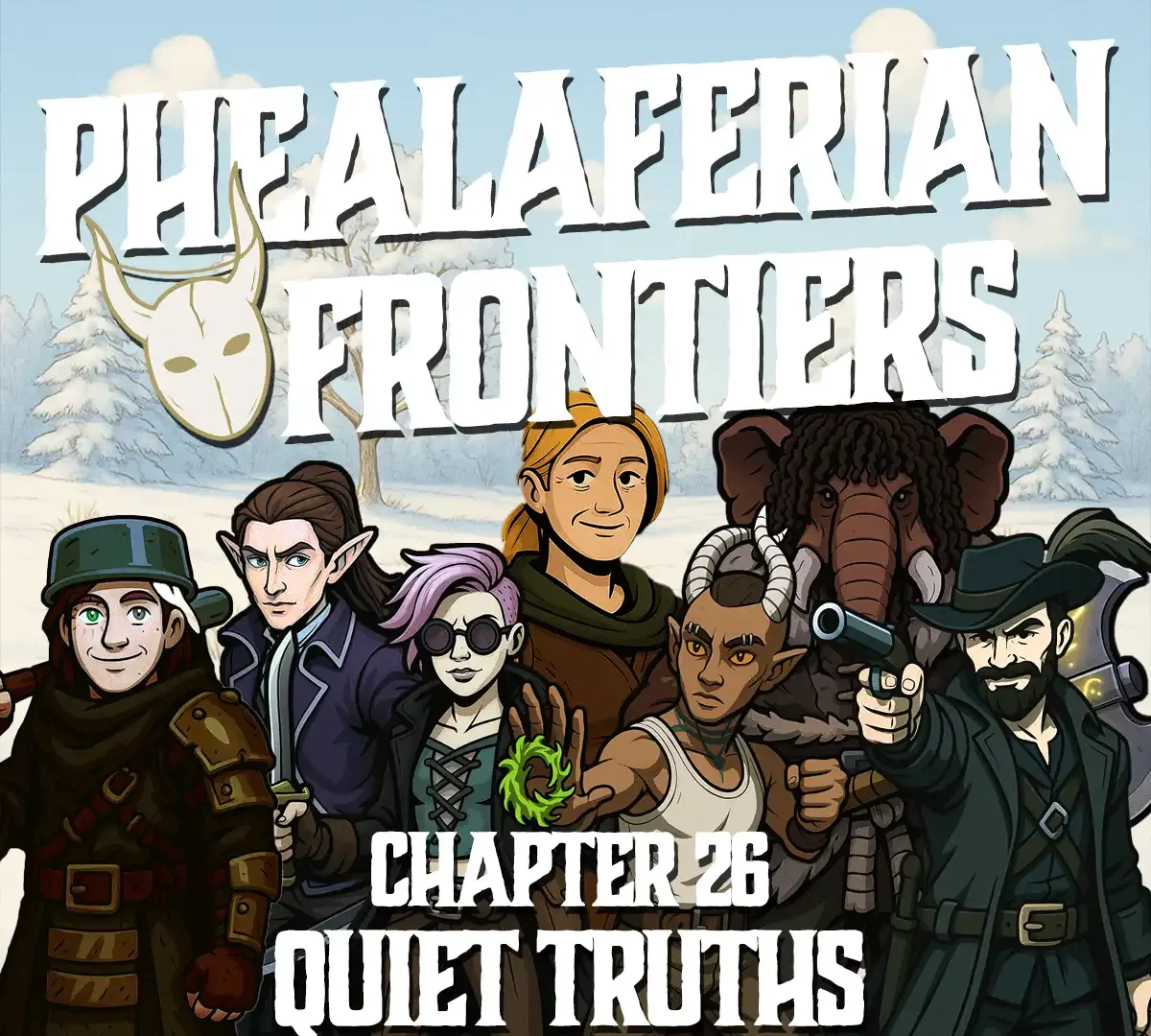
Phealafarian Frontiers : 26 : Quiet Truths
The others left quietly.
No words were spoken as Tobias, Zaryth, Tosk, Eldrin, and Thomas eased themselves away from Lyra’s home, instinctively understanding that this was not a moment meant for all of them.
The longhouse down the way was already alive with low voices and clinking cups, the warmth of firelight spilling out into the cold street. It did not take much encouragement for the night to drift into drink and distraction. Laughter rose and fell, stories half-told and retold, but even as tankards were raised, none of them truly left their thoughts behind.
Inside the small house, the fire burned low, casting long shadows across the walls.
Erisa sat opposite her mother, hands wrapped tight around a cup that had long since begun to cool. Her shoulders were tense, as though bracing herself for words she had waited years to hear and feared just as long. Guardian stayed close, present in every way that mattered, even if Lyra still had to look past him to where he stood. He listened, silent, letting Erisa’s questions lead where his own emotions threatened to overwhelm.
“Please,” Erisa said softly, breaking the quiet. “Tell me again. Why you left.”
Lyra closed her eyes, drawing in a slow breath. When she opened them, the years seemed heavier somehow, settling into the lines of her face. “I had a dream,” she said at last. “One that felt… clearer than any I’ve ever known.” She spoke of a voice that came not with cruelty, but with certainty—cold, steady, and impossible to ignore. The hag’s bargain, it warned, would be more faithful to its wording than anyone had understood. Morlatha had promised a child—and the voice made it clear she would be cruelly precise about what that meant. Not a youth. Not someone grown. A child.
“If I stayed,” Lyra whispered, her hands tightening in her lap, “if I watched you grow… the dream said you would die as you came of age. That it would happen only if I stayed, that my presence would be the thing that sealed it.”
Her voice broke. “I couldn’t take that risk. Not even a sliver of it.” She bowed her head, a tear dropping into her cup. “So I left. And every step away from you felt like carving something out of myself. I told myself that pain was better than burying you.”
Erisa swallowed hard, blinking back tears of her own. “Is that why you ended up in New Albion?”
Lyra nodded. “Eventually. I kept moving. Running, if I’m honest. New Albion was the first place I stopped long enough to breathe, long enough to be Lady Brightglade again, instead of a woman in flight.” A faint, sad smile touched her lips at the memory. “I built something there. I helped people. For a while, it almost felt like a life.”
The smile faded. “But I found myself on the wrong side of someone who would not be ignored, and I knew what came next. So I ran again. That’s when I chose Zaryth to take up the mantle. Lady Brightglade needed to remain in the city, even if I could not.”
Time stretched, the fire popping softly as the weight of old choices sat between them. The crackle of the logs seemed unnaturally loud in the quiet. At last, the conversation turned, carefully, hesitantly, to Guardian.
He spoke through Erisa, choosing his words with care. Of the Feywild and its warped beauty. Of Morlatha’s dominion, suffocating and absolute. Of the year of terror after his escape, hunted, half-mad, never certain which shadow might reach for him next. He spoke of Orthod’s destruction, of watching something precious burn because he could not save it.
Lyra listened without interruption. Her hands clenched in her skirts, knuckles white, breath shallow as the story unfolded. More than once she looked as though she might speak, only to stop herself and listen on.
At one point, Erisa rummaged through her pack and produced a folded sketch. It showed Guardian as he was, a horned tiefling boy with sharp features softened by youth, charcoal lines struggling to capture the contrast between infernal blood and a child’s uncertain eyes. Lyra took it with shaking hands, tears finally spilling free as she traced the drawing with her thumb, memorising every line. She laughed weakly through them. “Well,” she murmured, voice breaking, “that does explain why no one realised you were twins. A human girl and a tiefling boy… no one would ever think to look twice.”
They talked until they were all exhausted, words growing slower, heavier as the night deepened. Lyra insisted they take her bed, waving away protest with a firmness that brooked no argument, and settled herself into a chair by the dying fire.
Morning brought the others back.
The house filled once more with voices as plans were laid bare over reheated tea and stale bread. Tobias spoke plainly, as he often did: Morlatha was no longer a distant shadow. Timberwood proved she was active in Phealafara. If the party had a purpose beyond survival, it was to find her, and end her.
Guardian hesitated. “She dominated a dragon,” he reminded them quietly. “We are not ready. Not yet.”
Erisa’s hands tightened in her lap. “And if we do?” she asked, voice barely above a whisper. “If we actually find her… and end this. What happens to us?”
Lyra’s expression softened, some of the fear easing from her face as she reached across the table. “She helped me have you,” she said simply, looking between them. “That’s all. She didn’t make you, and she doesn’t own you.” She shook her head. “Whatever hold Morlatha has, it isn’t your lives. If she dies… you don’t. You were never hers to take.”
The question of where to go next did not come easily.
They lingered over it, voices low, cups forgotten as the weight of choice settled in. Stay in the Northlands, where the wounds were fresh but the ground felt honest? Return to New Albion, where old ties and unfinished duties waited? No one rushed to speak. Even Tosk, usually quick with an opinion, stood quiet for once.
Lyra listened to it all, gaze distant. At last she exhaled, a decision settling into her bones. “I’ll come with you,” she said, not loudly, but firmly enough that it cut through the room. A tired smile touched her lips. “I’ve run enough. If there’s a road ahead, I’d rather walk it than keep looking over my shoulder.”
The moment stretched, then a sudden flutter of wings broke it.
A raven alighted on the windowsill, black feathers stark against the frost-silvered glass. It cocked its head, unbothered by the room’s attention. A small note was bound to its leg. Lyra frowned, untying it with careful fingers, and read in silence before passing it to Erisa.
Husavik, a fishing town, two days’ travel. Ice Mephits haunting the river. Each day, the water froze solid again no matter how often the villagers cut through the ice. They had not been attacked, yet, but without fish, hunger loomed just as deadly.
“A small job,” Lyra said after a moment, more hopeful than convinced. “Four days there and back, at most.” She looked around the table. “If you take it, I’ll start packing what little I have left. Zaryth and Dandadan can stay here, make sure things don’t fall apart while I’m gone.”
They folded the letter away, gathered their gear, and by midday were back on the road once more, northward, toward frozen waters, cracking ice, and whatever waited beneath it.
The road to Husavik was cold, but mercifully kind.
Snow lay thick along the path, crunching beneath boots, hooves, and wagon wheels alike, but the way itself remained clear enough to travel without hardship. With lighter packs and well‑rested beasts, the party made good time, breath steaming in steady plumes as the Northlands stretched wide and pale around them. The cold gnawed constantly, biting fingers and numbing cheeks, yet it lacked the brutal, punishing cruelty of the mountains they had left behind. This was the sort of cold that endured rather than attacked—persistent, patient, and wearying in its own way.
Husavik revealed itself slowly.
Low wooden buildings clustered along the frozen riverbank, their timbers darkened by age and frost. Smoke rose thin and weak from chimneys that burned more out of necessity than comfort. Villagers moved through the streets with stiff, economical motions, wrapped head to toe in furs and wool, conserving warmth and energy alike. Their voices were muted, conversations short and practical. There was no panic here—only worry, and the dull exhaustion of people who had been enduring the same problem day after day with no end in sight.
When the party approached and spoke Lady Brightglade’s name, faces turned with cautious hope. Doors opened a little wider. People gathered, careful not to crowd. Words spilled quickly after that, overlapping as the story came out in fragments. Ice Mephits, they said. For nearly two weeks now. They came from upstream, gliding over the river’s surface like mocking spirits, laughing as they froze solid whatever water the villagers managed to break open. No one had been killed—yet—but frostbite had already claimed one fisherman’s foot, and others bore white scars on fingers and ears. Food was running low. The autumn harvest had been poor, and the river was meant to carry them through the worst of winter.
With little more to be gained from standing and talking, the party turned south, following the river against its sluggish, frozen flow.
About an hour later, the sound reached them first—a faint, crystalline chiming, like glass bells stirred by an unseen hand. It set teeth on edge. Ahead, the ice glittered unnaturally, catching the light in sharp, blinding flashes. Four Ice Mephits drifted lazily across the frozen river, their jagged bodies reflecting the pale sky as they circled and glided, utterly unbothered by the world around them.
The party took position along the bank, spreading out instinctively.
Tobias stepped forward alone, boots crunching as he set foot on the ice. The frozen surface creaked beneath his weight but held. For a moment, nothing happened. Then the Mephits turned as one, hollow eyes locking onto him.
They attacked.
Frosty shrieks tore through the air as the creatures surged forward, skimming low across the ice. The party on the bank opened fire at once—arrows, bolts, and crackling magic streaking across the frozen river—while Tobias and Tosk met the charge head‑on. Steel rang against ice‑hard claws. Frost shattered under heavy blows. When the first Mephit fell, it burst apart in a violent bloom of cold, shards spraying outward with numbing force that coated armor and skin alike.
The ice beneath them groaned in protest.
As the third Mephit exploded, the river cracked open with a sharp report, the sound echoing down the frozen banks. Dark water churned below as jagged fractures spread outward. From the widening breaks, more Mephits clawed their way up, dragging themselves free of the river as though born from it, their numbers growing as the ice failed beneath the strain of battle.
Even so, the fight never truly turned against the party.
Tobias and Tosk held the line on the ice, bracing themselves against repeated icy detonations, armor frosting over with each blast until they looked half‑entombed. Each explosion rattled bones and stole breath, yet they pressed on regardless. On the bank, the others adjusted quickly as rays of cold lanced out toward them and thick fog clouds rolled across the shoreline, swallowing sight and sound alike. They spread out, calling warnings to one another, firing through the haze as best they could.
Again and again, the ice cracked.
More Mephits rose from below, shrieking and swirling, the river itself seeming to vomit them forth as the battle raged on. Frost clung to lashes and brows, fog rolled and twisted in the air, and the frozen surface splintered underfoot, threatening to give way at any moment.
And still the fight continued.
